
 E-Invoicing, Deadlines & Practical Recommendations for Action

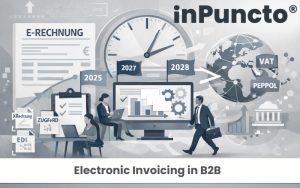
With the introduction of mandatory e-invoicing in the B2B sector, Germany is setting another milestone in the digitization of invoicing processes. While the receipt of electronic invoices has been mandatory since January 2025, the obligation to issue electronic invoices is subject to staggered transitional regulations until 2027 and 2028 respectively.
This raises a key question for companies:
How can these deadlines be used effectively—without creating future risks or unnecessary additional effort?
Electronic Invoicing: What Applies and When?
The legal requirements clearly differentiate between receiving and issuing e-invoices:
- Since January 2025
Companies must be able to receive and to process electronic invoices. - Transitional regulation for issuing invoices (2025–2026)
Invoices may still be sent:
– in paper form, or
– as PDF (with the recipient’s consent). - From 2027 / 2028
– A transitional rule applies in 2027 for companies with annual turnover of ≤ €800,000.,
– From 2028 onward, electronic invoicing will be mandatory for all companies..
Practice Shows: Forward Planning Pays Off Twice
Many companies view the transitional period as an opportunity to postpone the implementation of e-invoicing. In practice, however, this approach entails risks:
- Last-minute implementation pressure shortly before the deadline
- Higher project costs due to time constraints
- Poorly integrated, isolated solutions
- Lack of a foundation for future requirements such as real-time reporting
Companies that plan ahead not only ensure regulatory compliance but also realize measurable economic benefits.
inPuncto as a Strategic Partner for E-Invoicing Processes
E-invoicing is not an isolated scenario, but an end-to-end process—from invoice receipt to invoice issuance. The challenge lies in harmonizing regulatory requirements, technical standards, and SAP processes across the board. Real value is created through solutions that map e-invoicing processes holistically and integrate them sustainably into existing systems.
A Holistic Approach Instead of Isolated Solutions
inPuncto follows a full-service approach for e-invoicing processes. Instead of individual technical components, companies receive a seamless, SAP-integrated solution that covers the entire lifecycle of the electronic invoice—from setup to ongoing operations.
The benefit: Companies can focus on their core business processes while complex technical and regulatory tasks are handled centrally.
Relief Across the Entire E-Invoicing Process
With the inPuncto e-invoicing solution, numerous time-consuming individual steps—otherwise handled internally or coordinated across multiple service providers—are eliminated.
Typical efforts that are reduced or fully managed by inPuncto solutions include:
- Setup of technical connections
Structured and centralized integration of business partners, platforms, or networks. - Mapping to legally compliant e-invoicing formats
Implementation and maintenance of required formats such as XRechnung, ZUGFeRD, or EDI (CEN format), aligned with SAP document logic. - Testing phase and productive go-live
Coordinated test scenarios, validations, and a controlled transition to live operations.. - Seamless SAP integration
Direct embedding into existing SAP processes without media disruptions or parallel data storage. - Automatic Invoice validation
Setup of routines to verify format and content compliance (e.g. EN 16931). - Error analysis and resolution
Rapid identification and correction of technical or business-related deviations. - Maintenance and updates
Ongoing adaptations to legal changes, new versions, and international requirements.
More Than Compliance: A Foundation for Future Requirements
This holistic approach delivers more than legally compliant e-invoicing—it creates a central platform for invoice and tax data. This reduces data redundancy and establishes a consistent data foundation, which is a decisive advantage with regard to:
- international platform models
- PEPPOL connections
- future real-time reporting obligations to tax authorities
Conclusion: Use the Transitional Period Strategically—with the Right Partner
The transitional regulation for electronic invoicing gives companies the opportunity to prepare for upcoming mandatory phases in a structured and sustainable way.
With inPuncto as a strategic partner, companies benefit from:
- an end-to-end approach
- deep SAP integration
- reduced project effort
- a high level of future-proofing
This turns e-invoicing from a compliance requirement into a strategic asset.
From regulatory obligation to a scalable solution: keep and prepare your SAP processes for the German e-invoicing mandate 👉 Download our whitepaper now